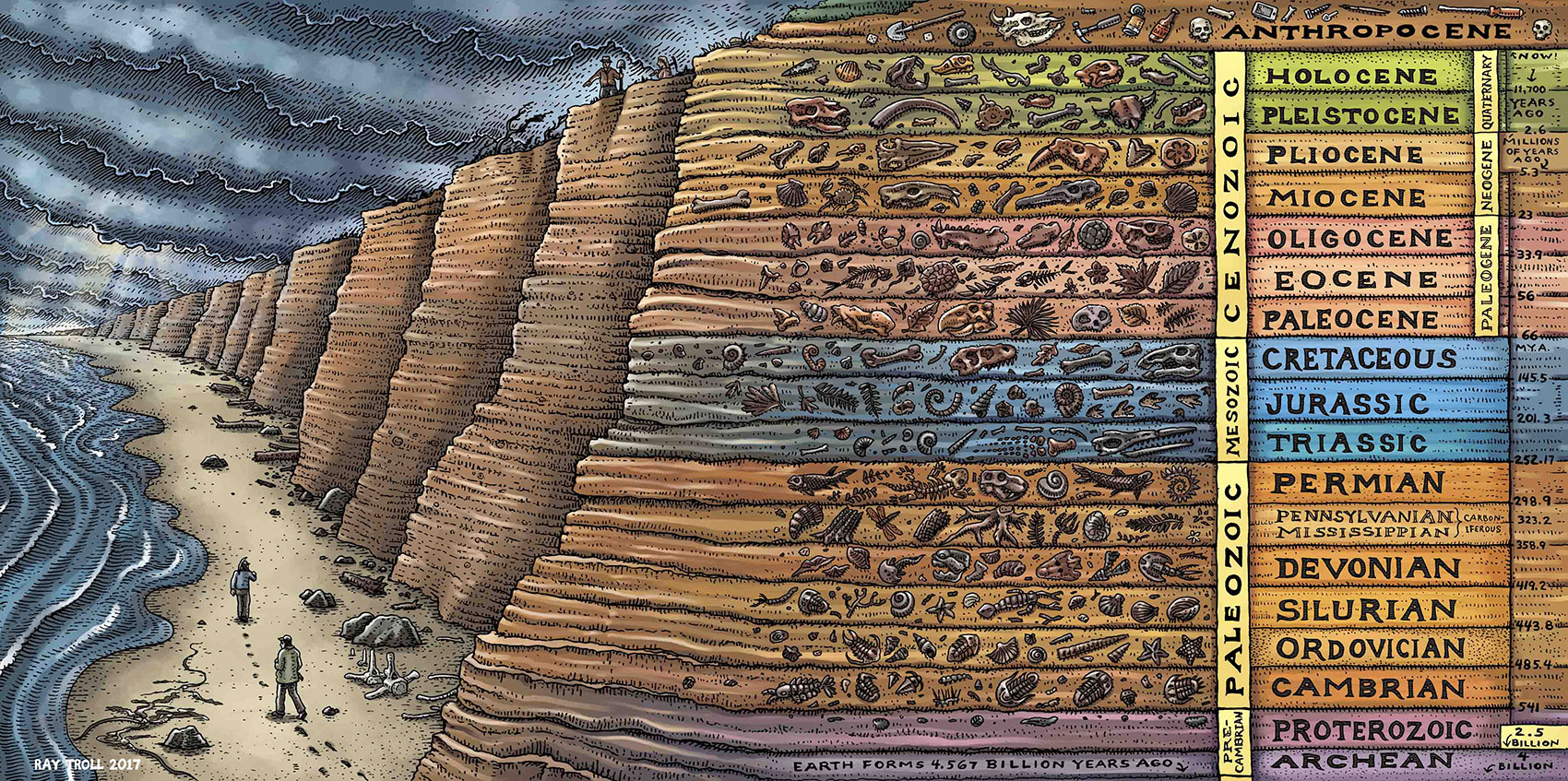
Are we living in the Anthropocene? And what would it mean to say that we are? These questions have sparked intense debate, particularly in 2023, when scientists clashed over whether human activity has altered the Earth so profoundly that it warrants recognition as a new geological epoch. The International Commission on Stratigraphy’s rejection of the Anthropocene proposal in March 2024 might suggest closure, yet the concept itself continues to thrive beyond geology. Rather than disappearing, it has gained new significance across the arts, humanities, and social sciences as a powerful lens for interpreting humanity’s relationship with the planet.
This Twine project engages with the Anthropocene not as a fixed scientific designation, but as a flexible and generative framework. While the formal proposal identified Crawford Lake in Canada as a key marker, this project asks: what happens if we begin elsewhere? By shifting focus to different places, objects, and ideas, the Twine invites users to explore alternative ways of understanding environmental change from the ground up.
This project was funded by a Knowledge Frontiers Symposia Follow-On Funding award from the British Academy. The building of the Twine was supported by The Plant at Maastricht University.
This project aims to bridge the gap between academic research and education by translating the outcomes of the Dutch–British collaboration Rethinking Values in the Anthropocene (RVA) into an accessible digital learning platform. It is driven by a central question: what is the value of the Anthropocene as a framework for understanding contemporary ecological challenges across disciplines? At a moment when the term is on the verge of formal geological recognition, the project investigates how its meaning shifts between the natural sciences, social sciences, and humanities, and why interdisciplinary engagement is essential to fully grasp its implications.
RESEARCH
This project aims to bridge the gap between academic research and education by translating the outcomes of the Dutch–British collaboration Rethinking Values in the Anthropocene (RVA) into an accessible digital learning platform. It is driven by a central question: what is the value of the Anthropocene as a framework for understanding contemporary ecological challenges across disciplines? At a moment when the term is on the verge of formal geological recognition, the project investigates how its meaning shifts between the natural sciences, social sciences, and humanities, and why interdisciplinary engagement is essential to fully grasp its implications.
APPROACH
The project adopts an interdisciplinary and practice-based approach, combining research translation with digital pedagogy. It will develop an interactive website featuring audio-visual materials collected during two international workshops in Bristol and Maastricht in 2024. These materials will be curated into an intuitive, user-friendly educational tool. Collaboration with digital media experts will support the design and implementation of the platform, drawing on methods such as audio-visual creation, data collection and visualisation, and prototyping to ensure an engaging and accessible learning experience.
DIGITAL ELEMENT
The digital core of this project lies in the development of an interactive, multimedia educational platform that translates interdisciplinary research into an accessible learning experience. The Plant will play a key role in enabling both the production and the presentation of this material. Beyond data collection, collaboration with The Plant’s specialists will guide the transformation of this material into a coherent digital product. This includes support in audio-visual editing, website design, and user experience development, ensuring that the platform is not only informative but also engaging and intuitive to navigate.
OUTCOMES
The primary outcome is a bespoke online educational platform designed for students and instructors at Maastricht University and beyond. The tool will make complex interdisciplinary research on the Anthropocene accessible through interactive and multimedia formats, supporting teaching in programmes such as Digital Society and Global Studies. It will also serve as a resource for thesis research and broader environmental education. More broadly, the project demonstrates the value of integrating research and teaching, while addressing a clear gap in the availability of accessible, interdisciplinary educational materials on the Anthropocene.